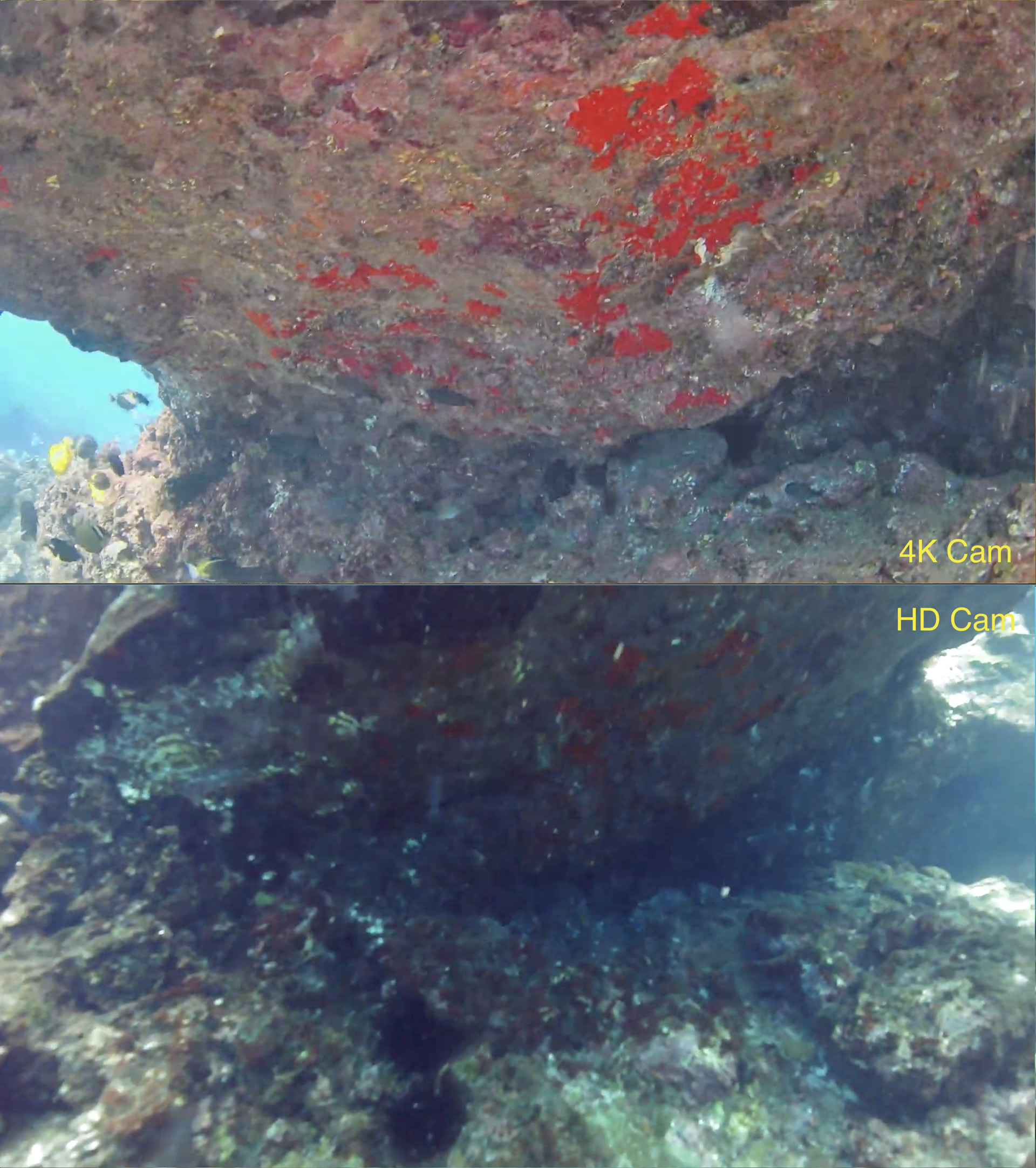
Hiya folks, welcome to the new category - celebrating and sharing epic adventures and vibrant details captured with our new 4K Cam!
To kick things off, here’s a collection of comparison screenshots from recent footage captured by @tony-white and some others in our R&D team! This isn’t footage, but there’ll be plenty of that to come
@EliotBR Hello! I am a newbie to the fascinating technical aspects of your products. I used Claude Opus 5.5 to help me overlap elements of the technical guide onto your YouTube video at https://youtu.be/Q66l0RXHv6Q
This is a spec draft (not only is it too rough, but I’d never share “publicly” without your permission, of course … and several details aren’t correct such as the font doesn’t match yours). I thought you might like this attempt at improving the communication of the technology to, well, people like myself (aka, a general audience).
Just by ingesting your technical page into Claude, I myself learned the importance of the latency and treatment of color (~ 0:29)–how water “strips” red light first–actually, I learned it by having Claude help me prioritize the messaging.
That’s what sort of interest me (as a general newbie): how to approach and understand the technology as a non-expert.
In any case, I hope you like it! Thanks, David Harper
Thanks @davidh_altasea -
Definitely one error in that AI output - we don’t use standard ethernet tether but instead communicate with the Fathom-X tether interface system. This allows for much longer tether lengths! I didn’t see anything else factually incorrect…
Ah, thank you @tony-white I totally missed that. Now i understand: although there is an onboard 10/100 Ethernet switch, that switch “mounts directly on the Fathom-X” board (per Fathom-X Tether Interface for Long-Range Ethernet Over Twisted Pair) which itself is the key to enabling a depth of up to 300m (as tested by BR). And there is a second Fathom-X at the surface. The combination of tether length and latency is super cool. I can’t wait to try this hands on.
Thanks for examining (Claude’s) output. I will fix this in the next iteration …